Introduction to Vangelis
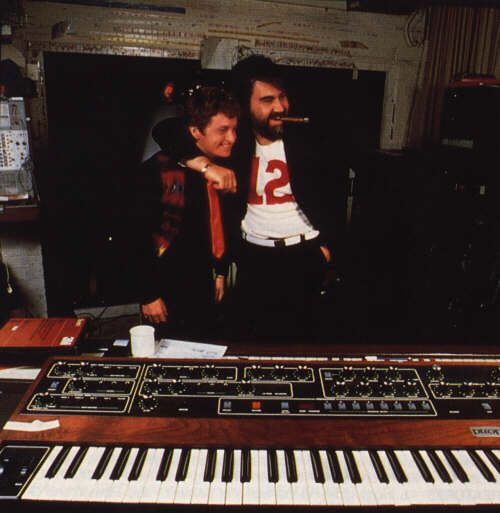
Vangelis is a world-renowned Greek composer, keyboardist, and multi-instrumentalist. He mainly composes instrumental and film music and he performs all the music by himself. During his career he has flirted with many genres and his music proved to be very hard to categorize. His music has been filed as "synthesizer music", "electronic music", "new age", "progressive rock", "symphonic rock", "space music", "electronic music", etc. etc. None of those terms is spot on and his output is too varied to catch in one word.
He was born as "Evanghelos Odyssey Papathanassiou" on March 29th 1943 in a small town near Volos, Greece. He started playing the piano at the age of 4 and gave his first public performance of his own compositions at the age of 6. During his student years he was the founder member of a successful Greek pop band called the "Forminx". In the late 1960s he moved to Paris and formed the band "Aphrodite's Child", together with singer Demis Roussos and drummer Lucas Sideras. They scored many hits all over Europe. In 1970 the group broke up and Vangelis started a solo career. In 1975 he moved to London where he set up his legendary Nemo studio that he used to record many of his famous albums and soundtracks. Most legendary are perhaps the Oscar winning score to "Chariots of Fire" and the ever popular score to Ridley Scott's landmark film "Blade Runner". In 1987 he left London and subsequently recorded music in Athens ("Direct", "Voices"), Rome ("The City"), Paris ("1492") and Athens again ("Voices").
Apart from creating music, Vangelis also exercises in other forms of art including painting and sculpting, which he has been doing throughout his life. Only recently has Vangelis come out of the limelight as a painter, showing his work on a small number of exclusive exhibitions.
What instrument does he play?
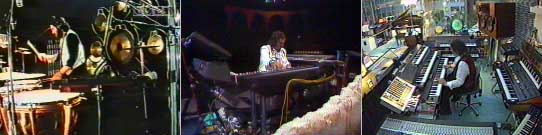
Keyboards are his main stable of instruments, either as synthesizers and other types of electronic keyboards, or grand pianos. He is also a multi-instrumentalist and is proficient with playing percussion, drums, as well as a diverse collection of instruments such as flute, vibraphone, tabla, harpsichord, clarinet, tubular bell, timpani, cymbal and gong. Sometimes he incorporates into his music a choir ensemble, guest vocalists, or arrangements for a symphony orchestra.
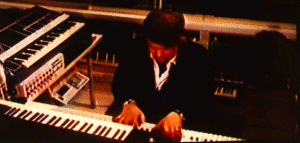
In most instances synthesizers and electronic keyboards form the basis of his work. Having harnessed technology to suit his personal style, he performs as many parts of a composition in one single performance. He surrounds himself with keyboards, and with the use of foot pedals, modules, and a mixing desk, and improvises his music straight onto a recording. His quick methods makes it possible for him to record a piece of music in very little time, working instantly on composition, arrangement, production and performance, keeping the result fresh and spontaneous.
What does he do?
Besides releasing albums he records music whenever he likes. Sometimes he composes music for films, stage plays, special events, etc. He rarely performs in public and allows very few interviews.
Have I perhaps ever heard his music?
Probably, yes. His music has been used for many purposes. What you most likely heard differs per country. A few possibilities:
The German boxer Henry Maske used Vangelis' theme for the film "1492, the Conquest of Paradise" (1992) as his victory tune in 1995. As a result of this the CD single and later the album were re-released in Europe and reached the tops of most of the charts.
Interesting to note is that Maske never got to meet Vangelis. Maske: "Ich lad' ihn immer ein, aber er kommt nie. Er ist zu sensibel furs Boxen." (I invited him often, but he doesn't come. He's too sensitive for boxing.)
Also heavy weight boxer Tommy Morrison from the USA used this track, but it did not result in any success. Neither for the music nor the boxer.
The main theme for Hugh Hudson's period sports drama "Chariots of Fire"(1981) won Vangelis an Oscar (tm) and both album and single ruled many of the pop music charts at the time. Thereafter it was used as theme for the Olympic games in Sarajevo in 1984. Ever since it managed to pop up in just about every documentary about the Olympics or athletics and appeared in many commercials all over the world. Most notably in a newly recorded version by Vangelis himself in Ridley Scott's "Citroen Xantia" commercial.
-
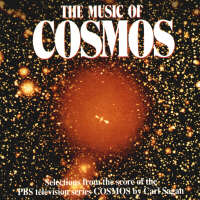
Carl Sagan's famous television series "Cosmos" used a lot of Vangelis' music. Selections were heard from albums like "Heaven and Hell" (1975), Ignacio (1975), Spiral (1977), and Beaubourg (1978). The show's main theme was an excerpt from Heaven and Hell part 2. A reedit of the series that was broadcast years later did not feature as much Vangelis music as the first edit did. Parts of Vangelis' music appeared on a "Cosmos" compilation album (LP/CD), together with classical selections and recordings by Tomita, Synergy and others. In 1986 Sagan made a special edition of Cosmos which had some new music written by Vangelis especially for the occasion. Most of this music was never released, except for Vangelis' new main theme, released on a 2CD recompilation of the Cosmos soundtrack album, now sadly out of print.
In the Netherlands music from "Spiral" was used as theme music for the popular science-show "Wondere Wereld" while "Kinematic" from the "Antarctica" album is often recognized as the "action music" from "Wedden Dat?"
In the USA and Italy, commercials for "Gallo Wine" used the track "Hymne" from the album "Opera Sauvage" (1979), but in a special version rearranged by Vangelis.
In the early 80's Ford used the opening of "Chung Kuo" from the album "China" in their commercials for the "Mercury Lynx" while Chanel used "The Little Fete" from the same album around the same period for promotion of their "Chanel 5" perfume.
Other famous usage includes "Conquest of Paradise" for the trailer for Brian De Palma's "Mission To Mars" film (although confusingly there was also a version using Basil Poledouris' music), Conquest was also used in Australia by the Westpac Banking Corporation in 1997-1999 and by Orlen in Poland in 2003, "Chariots of Fire" was used in various commercials - most notably as a specially reworked version by Vangelis himself in '93 for Ridley Scott's Xantia promotion - and Missing was used in a South African advertisement campaign. Mythodea was used in the trailer for "X-Men", which can also be found on the DVD release of that movie.
Blade Runner's music was used in the States for a Vicoria's Secret commercial (love theme) and in Japan for a Toyota commercial, while Ridley Scott used some of it in the UK for a series of anti drugs infomercials.
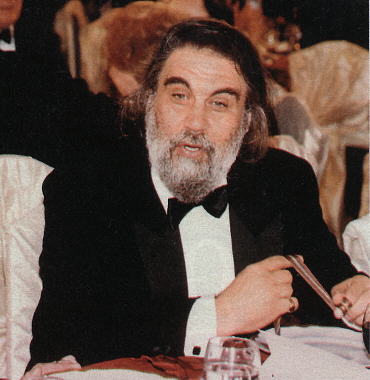
Some Personal information
Vangelis avoids public appearances. He rarely gives interviews and concentrates on making music. He hates gossip and tries to stay out of the limelight
During his career he lived in Greece ('43 / '68), Paris ('68 / '74), London (Nemo studios '74 / '87), Athens ('87 / '91), Paris (Epsilon laboratory 1991 / 1993). He also spend some months in the USA (1986) and Rome (1989).
Vangelis' last known studio was the "Epsilon Laboratory" in Paris, which was build mostly from glass on the top of a high building in Paris. Since 1993 Vangelis has apparently been moving around a lot, being labeled some sort of "nomad" by the media. He occasionally returned to Greece, his native country, where he allegedly recorded some of his recent albums (Oceanic, El Greco).
He has a brother named Nico, who also worked in the music business, but functioned mainly as producer. Nico would sometimes record Italian pop albums for Polydor in Vangelis' Nemo studio in London in the late seventies.
What next?
So you've browsed through this site and want to know what's next?
Other fan web-sites
The first fan site dedicated to Vangelis was set up in 1994 - named "The man and his music" - it was created up by Michael Perkhofer and Stephen Bowline. A large site for its time, it contained digitized images, audio clips, and lists of Vangelis' works for film, collaborations, concerts, and albums. Sadly the site stopped updating in 1998 and quickly became outdated. A decade later it went offline but many fans remember it fondly.
Don Fennimore's Collectors corner has all the details you could ever need about Vangelis' discography, with tips on collecting. It updates less frequent updates but it remains an essential resource for collectors.
Antas' Odyssey site has some rare pictures, MIDI files, music sheets of Vangelis' music. More recently he established a Vangelis rarity website with information on Vangelis rarities.
The lyrics site by Henk Engelen contains a lot of information on collaborations, with transcribed lyrics of any music of Vangelis that has the human voice.
The Vangelis Movements site started with a simple page by Robert Eichelsheim, and now has grown into a full fledge site with a great amount of information. The site is particularly useful for doing research and other less known Vangelis' works.
There are also various small sites that are worth checking out. You can find links to all these sites and more, in the links section of "Elsewhere".
The Direct Mailing list
One of the most recommended perks on the internet is the DIRECT mailing list, maintained by Keith Gregoire.
A mailing list is an E-mail service allowing discussion, which can be joined for free by anyone who is interested. Everyone who subscribes to this list can join discussions be sending e-mails to one specific E-mail address, which then forwards to every subscriber. This allows you and hundreds of other fans to communicate with each other about their shared interest, in this case Vangelis and his music.
Since 1996, the Direct mailing list, founded in the very early nineties, has been incorporated into the "Vangelis" yahoo group, which means that the discussions can also be joined or followed on yahoo's groups web site, without using an email address.
Details on how to join can be found in the links section of this site.
There used to be a widely accepted FAQ document about Vangelis, originating from the old DIRECT mailing list, but that hasn't been updated since 1993.
Mark Griffin's book
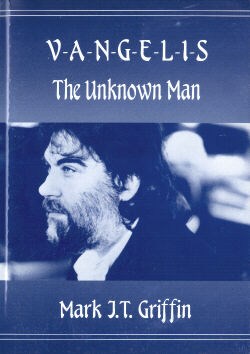
Another source of information is a book about Vangelis, called "Vangelis - the Unknown Man" by author Mark Griffin. The texts are primarily based on collected articles and interviews, and both Vangelis as well as the original article writers are quoted extensively, often without proper references and sometimes taken out of context. There are also many mistaken speculations (ie: Not Milva but Vilma Lado sings on Astral Abuse, "Comet" is not an unreleased album but the music for the '86 Halley's Comet edition of Cosmos, Guy Protheroe did not write the 'lyrics' for 1492, "Diner Les Bustes" does not contain original Vangelis music, etc.) This book was written in 1994 and released on a rather small scale. It was updated by Griffin for a second edition in 1997, limited to only a thousand copies. It can be difficult by now to find an unused copy, except in the UK where some bookstores (and the British Amazon.co.uk) are still able to deliver it. ISBN 0-9523187-2-5.
For a while there was also Mark Griffin's international fan club called "ALBEDO", producing a fanzine that was due to appear twice per year. However, Griffin has suspended his activities after the ninth issue (November 2000.)
Spanish book
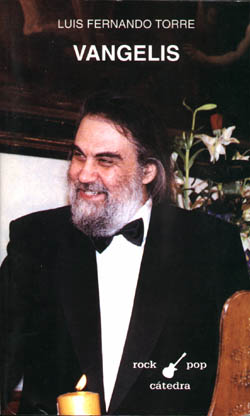
In Spain, the pocket series "Rock/pop cathedra" published a book called "Vangelis" (nr45) by Luis Fernando Torre. All texts are in Spanish. Some album covers are displayed in color. The book follows Vangelis' career chronologically, dealing with the Forminx, Aphrodite's Child, his solo work and his collaborations. There's a rather good discography as appendix. ISBN 84-376-1595-X. Latest edition 1998.