This page lists all known live performances by Vangelis, in reverse chronological order.
Vangelis has never been prolific at performing on live occasions, and the intervals between these rare events have become bigger as time passes.
Some of the descriptions on this page are based on audience recordings, often in bad quality, as this is now the only way to have an idea of the kind of music that was played at these events. Should you have memories of actually attending a concert, please consider submitting an eye witness report (elsew.com@gmail.com), in order to more accurately represent the spirit of the occasion.
Opening the Katara Amphitheater in Qatar (Doha, Qatar, December 11, 2011)
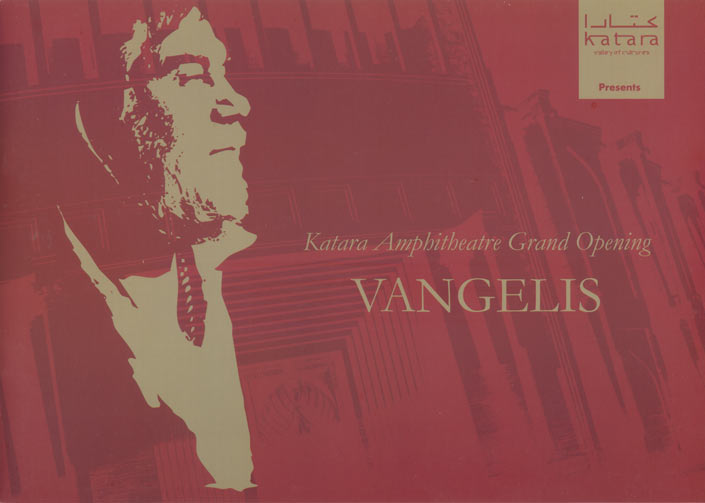
In a rare and special one-off event, Vangelis composed and performed at a concert that simultaneously opened Qatar's new giant amphitheater on the grounds of the Katara Foundation, while celebrating the occasion of the gathering of the United Nations' Alliance of Civilizations in Doha. Participants of the forum were invited to witness the concert, which, due to its connection to the convention and a large number of high placed dignitaries (ranging all the way up to Ban Ki Moon) attending, was not open to the general public. Security was tight, even for those who were invited.
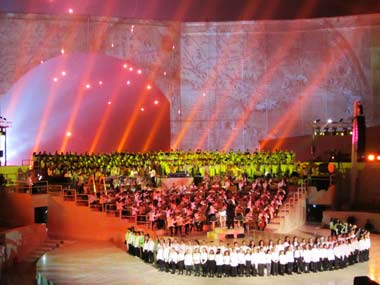
Vangelis performed from behind his synthesizer setup, together with Qatar's Philharmonic Orchestra, the Yurlov Russian State Academic Choir who were flown in from Russia for the occasion, and appearances by master of ceremonies Jeremy Irons, tenor Roberto Alagna and a major role for the soprano vocals by Rumanian opera star Angela Gheorghiu. The spectacular light show was conceived by the legendary Gert Hof, whose sad and unexpected passing shortly after the concert unfortunately made this his last light show spectacle.
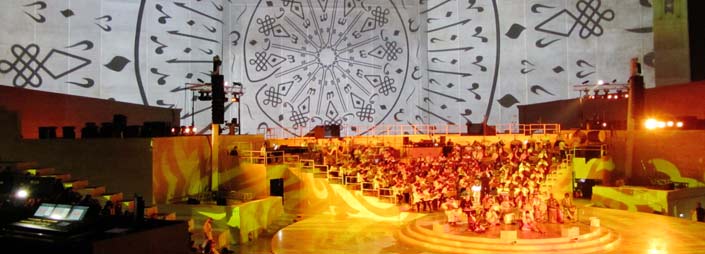
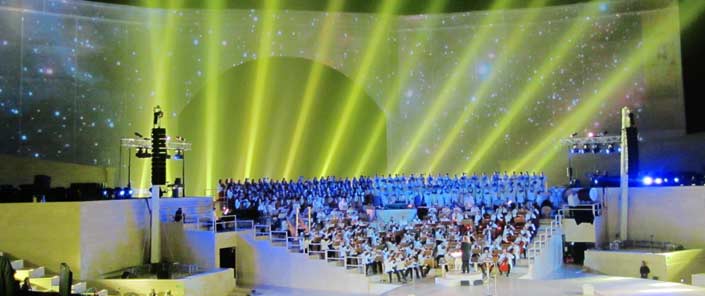
High resolution moving imagery was projected onto a specially build screen of almost 50 meters high and 150 meters wide, of which a section could open up. This allowed a well timed view of the Gulf, revealing a fleet of traditional Qatari ships and additional lights to seriously expand the concert venue beyond it's own confines.
The concert was filmed by Chariots of Fire director Hugh Hudson, and recorded for a release, but as of yet, this remains only a promise: No date or release details have been announced on either CD or DVD, even though both are in the pipeline.
So far, only a few short scenes from the concert were released to the media, as seen in the Al Jazeera television interview that Vangelis gave in Doha, some time after the event.
Musically, the concert was divided into three acts, where the opening act gave a lead role to a group of traditional musicians, brought in from around the world, performing and improvising to the backdrop of Arabic music.
The second acts involved the performance of a new Choral symphony by Vangelis called "Hope", an orchestra and synthesizer based work, classical in sound and somewhat in the tradition of Mythodea, with Angela Gheorgiu performing soprano vocals on roughly half of the tracks.
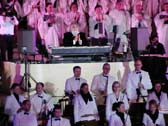
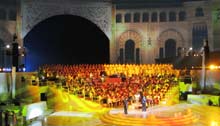
Finally, the Third acts consisted of an instrumental version of the new "Child of Hope", a duet by Roberto Alagna and Angela Gheorgia ("Piccola Boheme"), as well as refreshing new performances of Chariots of Fire and Conquest of Paradise, both combining the orchestra with synthesizers, shifting the light show spectacle in its highest gear. Finally, "Child of Hope" was performed with a children's choir as well as the Russian choir, proving that music can be both cute and moving at the same time. Lyrics for this track were composed by the great Tim Rice.
Please follow this site's news section for any upcoming information on the release of the concert, or the "Hope" album.
Mythodea (Athens, June 28, 2001)
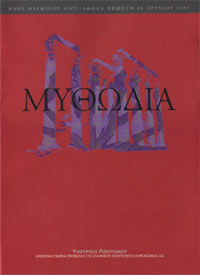
How do you improve on an already memorable 1993 concert? Easily, by teaming up with Sony Classical, the Greek government, NASA, the London Metropolitan Orchestra, the Athens Opera Choir and sopranos Kathleen Battle and Jessye Norman. Then, by perfecting it to the last small detail into an audio visual treat to overwhelm but also tantalize its audience.
The first project Vangelis worked on when he signed with record label Sony was a reworking of his 1993 concert Mythodia (the Greek spelling leaves some room for interpretation in English spelling), this time enhanced to use a full blown symphonic orchestra, in addition to the harpists, giant choir, timpanists and 2 sopranos. So now, even before the album has been released Greece has seen been shaken by this historic event. Initial local hesitations over the high budget and use of an archaeological site where quickly forgotten when both audience and press hailed the concert as an artistic masterpiece as well as a wonderful promotion of Greece to the outside world.
The concert, performed at the historical Temple of Zeus in the center of Athens, was witnessed by 2000 people in a seating construction set up especially for the event, while another 30000 people watched a free live cast of the concert on a giant screen in the nearby Panathinaiko stadium...
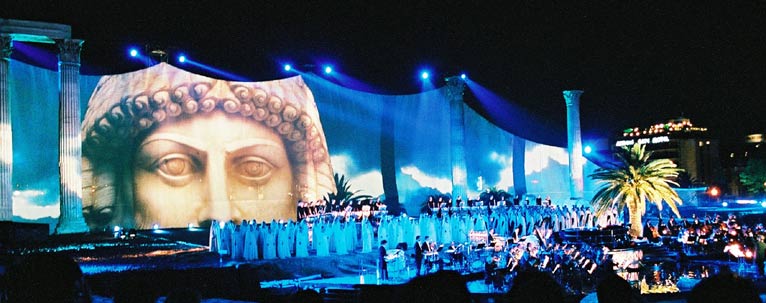
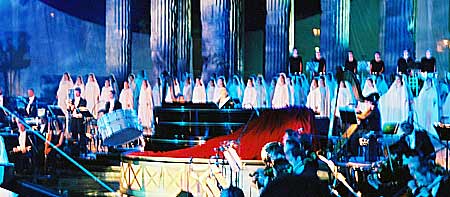
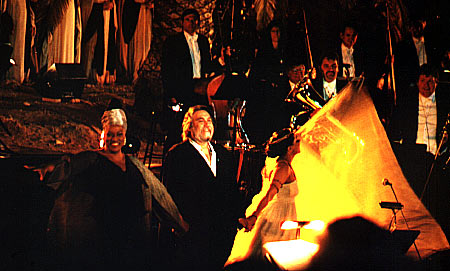
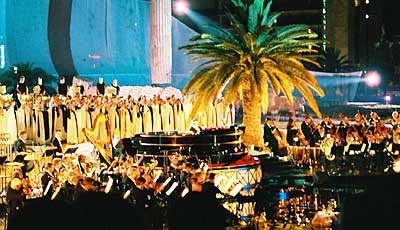
Behind the stage of the concert itself a giant screen was erected behind the temple to allow images and colors to be projected behind the stage that held the choir, timpanists, orchestra, the two soprano's (Kathleen Battle and Jessye Norman) and Vangelis in his centralized synthesizer island.
The music performed was the same as is going to be released on the Mythodea album, except not all movements were segued into each other, so there was some time for audience reaction and probably also for a few seconds of rest for the orchestra, choir and other performers. After all the Mythodea movements finished, the ovation called for the three planned encores, being orchestrated versions of Chariots of Fire and Conquest of Paradise, and finally - at which point the press was allowed in to film and take pictures - a reprise of Mythodea's last 2 (connected) movements. The entire concert was filmed by Sony Classical and released on VHS and DVD. A slightly different edit of the registration was broadcast on many TV stations throughout the world.
Realmedia (video): Download euronews_mythodea.rm (2796 KB, 2:30) or stream euronews_mythodea.ram (150 KB/s, 2:30).
Also see the:  Eyewitness reports from spectators.
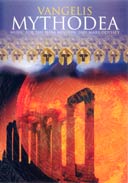
The Mythodea DVD (and VHS) release was the first time a Vangelis live event was made into a consumer release. The concert is beautifully filmed, and the concert is interesting, both as reminder of the event and as an experience on its own. Sadly, the sound of the concert (which in reality was almost entirely an authentic live performance) was replaced by the studio recording that we know from the CD, probably because Sony intended the TV broadcasts as promotion to sell the album. The only exception is the "Chariots Of Fire" performance at the end, which indeed uses the sound as recorded on the event. "The Conquest of Paradise" and the reprise of Mythodea's last two movements were omitted. The concert begins with a short introduction by NASA's Scott Bolton. The DVD's extra's involve the video clip for Mythodea's "Special Edit" and a "Making Of featurette" which includes interview snippets and behind the scenes footage.
Opening ceremony Athletics WC (Athens, August 1, 1997)
This big spectacle which opened the World championships in Athletics which was held in Athens, the initial cradle of the sport. Vangelis was chosen to organize the show, which was extra important in light of Greece's bid to organize the Olympic Games in 2004. Organizing in this case meant total control over the show, the dances, the lights, the music, etc...
The event took place in the Panathinaikon Stadium where more than a hundred years ago the first modern Olympic games had been held. The biggest part of the show was only organized by Vangelis. He did not yet show up himself. It started with parades of the athletes carrying flags. It was accompanied by a symphonic orchestra playing Vangelis music, including new pieces and new arrangements.
It was followed by the formal opening, including some speeches. At this point the anthem for the IAAF, a new composition by Vangelis was heard for the first time.
The third part of the event started the real show. It existed of dancing, combined with a mix of computer graphics on 5 huge screens, spectacular lighting effects projected on surroundings and the entire arena and of course the new music by Vangelis.
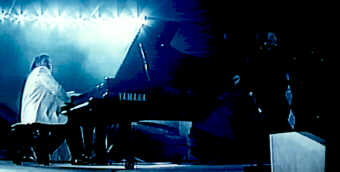
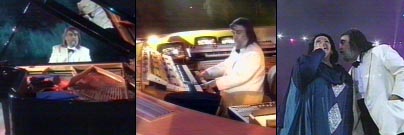
Finally Vangelis himself entered and performed two famous pieces: Chariots of Fire and Conquest of Paradise. They were followed by the entrance of Montserrat Caballe and here daughter Montserrat Marti. All together they performed a new track called "A Prayer". Then without Marti "March with Me" was performed (or rather, playbacked).
Officially the show now ended with a spectacular display of fireworks, but after the fireworks Vangelis sat down at his synths again and started performing the Greek national anthem.
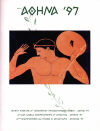
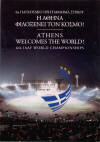
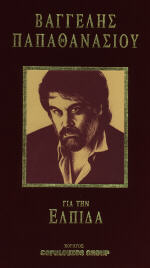
The show had two programs, one was a booklet with amongst others a new picture (b/w) of Vangelis and a text (upper picture). The other was a little foldout brochure to welcome people to the event, and it featured 4 pictures of Vangelis (lower picture).
The entire event was broadcast live on TV, on stations like the Greek ET1 and all over Europe at Eurosport. For visitors there were two program books, one of the show itself, and one to welcome people to the championships. Both had pictures of Vangelis.
Little more than a month later the Olympic committee made the decision to award the organizing and hosting of the 2004 Olympic Games to the city of Athens.
Also see: Athletics '97 pictures for a collage of photographs from the live TV broadcast.
And also see the: Eyewitness reports, where various spectators who attended the event itself share their experiences.
For more information you can browse backwards in this site's latest news section from the late '90s.
Mythodia (Athens, July 13, 1993)
  |
|
|
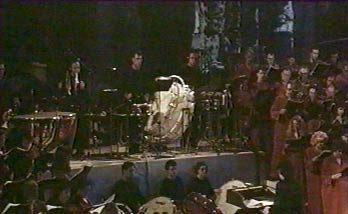
The music performed at this concert remained a mystery for most fans for a long time, until it was spectacularly re-performed at the Temple of Zeus and released as an album in 2001.
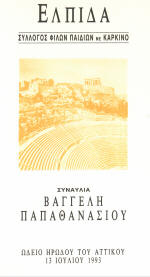
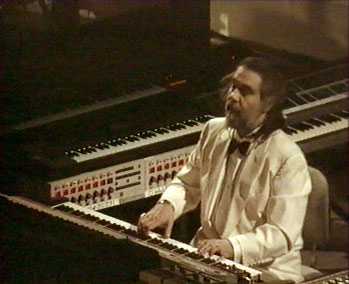
The original Mythodia was a piece in 7 movements, performed at the Herodium theater of the ancient Acropolis in Athens. Amongst the performers were Markella Hatziana, Luccienne Deval and a chorus, directed by Yvan Cassar. It was organized by the famous Elpida foundation, to benefit children with cancer.
The music was sensitive - but also majestic - in Vangelis' synth-orchestra fashion, featuring enigmatic opera vocals, thundering timpani sounds, fierce cymbal crashes and choirs to support it all. All elements combined, in tasteful balance.
At the end Vangelis played a selection of his well known tunes including La Petite Fille De La Mer, Chariots of Fire, Pulstar, Hispanola, City of Isabel and Conquest Of Paradise, before finally finishing the event with a glorious performance of the Greek national anthem.
In the audience some of Vangelis' famous friends (Roman Polanski, Emmanuele Seigner and Irene Papas) turned up as VIP, receiving a painting of a mother with a child in her arms and the following words written inside it:
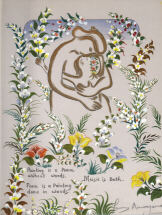
"Painting is a Poem
without Words,Poem is a Painting
done in WordsMusic is both."
Also see the: Report on Mythodia, as Diego Lugon witnessed this concert in person and shares his experience with us.
The Night Of Poetry/"Antigone" de Sophocle (Athens, October 3 1991)
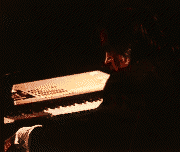
In October 1991 the "Night of Poetry" was held for "the World Society of Poetry, Drama and Literature" at the "Herrod Atticus" in Athens. Vangelis played sensitive background music over which guests recited poetry in various languages (Greek, French, English). Those guests included Alan Bates and actress Fanny Ardant. The poetic performances were intense and overwhelming. Vangelis' music brought a very special touch to them and the combined effect was undeniably strong.
Sadly the audience didn't show much respect to the music by cheering loudly at the end of each recital while Vangelis, who played all music purely live (unlike for instance Eureka, earlier that year), was still trying to finish his music. From his appearance he seemed most unpleased by this.
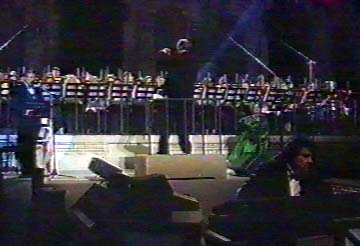
The style of the music can be compared to the music in the "Musiques Au Coeur" television interview, but also
with El Greco and Rapsodies. Especially "Asma Asmaton" on this last album is a good example since it has comparable emotional reciting.
The second part - after the break - was a short opera, "Antigone", featuring Markella
Hatziano (Glorianna from "Direct") her powerful soprano voice.
Support came from the "Athens Opera Choir" conducted by Guy Protheroe (H&H, Mask, 1492) in the form of their singing and some artistic banging with sticks.
The entire event was broadcast live on Greek television on the ET1 channel.
For an impression you can download three soundfiles in the MP3 format (22KHz, mono, 32kbits/s).
MP3: poetry.mp3 (215KB 0:54 sec), excerpt from a thundering poem in Greek with Vangelis playing.
MP3: antigone.mp3 (244KB, 1:02 sec), Excerpt from soft opera song from Antigone.
MP3: antigon2.mp3 (967KB, 4:07 sec), A dark opera song from Antigone, with ovation.
"Eureka" (Rotterdam, June 18 1991)
This concert was organized by the Dutch ministry of Economic affairs to promote and celebrate the "Eureka Project"; an initiative to stimulate international scientific cooperation between European companies. Vangelis was asked to provide the highlight of the event.
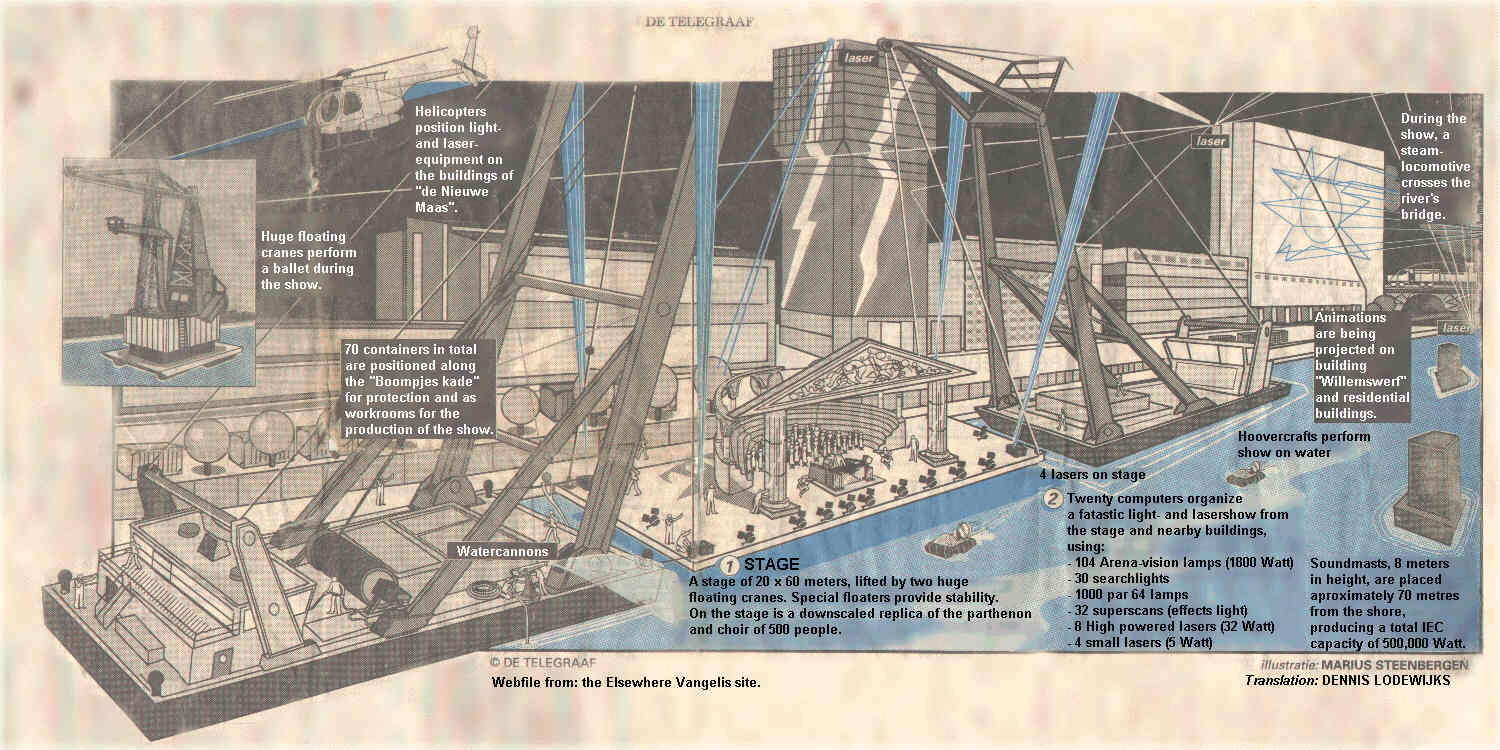
The concert took place at the docks in Rotterdam, the Netherlands. A floating stage was constructed. Vangelis was seated in the
middle, surrounded by his synths and some classically Greek styled props. He was backed up by a choir.
To accompany the music some buildings in the neighborhood were used for projections with colors and laser animations.
Furthermore there were participating choppers, boats and movable cranes.
Jon Anderson appeared as guest for the track "Italian Song" and Markella Hatziano (who reportedly tripped over the wiring afterwards) appeared for "Glorianna".
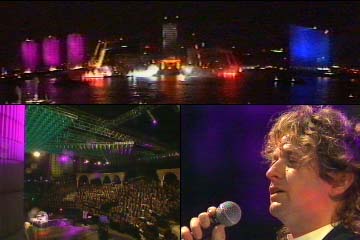
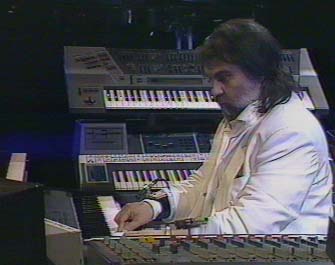
Sadly much of the music was not actually performed live. Vangelis played played along with pre recordings, but most of his playing was mixed so soft it was hard to catch. Most of the tracks were shortened versions of famous tunes (like Chariots of Fire, Pulstar, Spiral) as well as tracks from "Antarctica" and "Mask". The performance ended with a spectacular choral version of Hymne, which was later released in a slightly different mix/edit on the compilation album "Portraits {So long ago, so clear}" (1996). An encore was planned to be performed (and announced in the TV broadcast) but it had to be canceled because the bad weather had made it impossible.
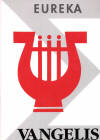
The concert attracted an audience of more than 150,000 spectators. There was a program with a picture of Vangelis and texts in Dutch and English. See the picture of the cover. Also on sale were T-shirts with "Eureka" and "Vangelis" printed on them.
There was a live broadcast by Dutch television station Veronica, while RTP Madeira broadcast it on Portuguese TV a few years later.
Also see the: Eyewitness reports, from people who were there to attended the concert.
This big concept sketch, with a visual diagram of the concert's setting was printed in Dutch newspaper "De Telegraaf". Translated by Dennis Lodewijks.
"Song For Athens", Olympic Promotion Concert (Athens, 1990)
In September in 1990 Vangelis performed a concert in front of 80,000 spectators at the Olympic "Panathinaikon" stadium in Athens. The goal of it was to promote the election of Athens as host for the 1996 Olympic games. As it turned out Athens was passed in favor of Atlanta in the USA.
The most notable theme played was a bombastic melody, in a way perhaps reminiscent of "Hymne". Performed in an orchestral style, using lots of choir, harp and orchestral percussion this gave a fresh new sound to the Olympic spirit. Except for some recordings during the opening, no 'greatest hits' where performed, only new and probably (partly) improvised music, most of it bombastic, triumphant and romantic of nature.
A tape recording of some sound checks of this concert is known to circulate among fans and collectors. It includes two short appearances of classical pieces including Beethoven's 9th symphony, quickly transcending into Vangelis' own music. This was however not performed on the concert, Vangelis was just playing around.
The event was broadcast live on Greek television, but a commentator tried to spoil it by talking over almost all the music.
Terme di Caracalla (Rome, July 17 1989)
Vangelis performed a beneficial concert for research against cancer in Rome. Some of the preparations for this concert can be seen at Polydor's promotional video for Themes, and roughly the same material plus some other cuts was broadcast by Superchannel as an impressive special about Vangelis.
The concert's style was comparable to the Los Angeles concert, in that Vangelis improvised a lot of music, incorporating some famous melodies in totally new ways. He played solo in the middle of the stage, with layers of sound, using his Direct technique. The familiar tunes that were played include Alpha, Pulstar, Memories of Green, Long March (in a particularly moving version with piano sounds), Missing, Love Theme from Blade Runner and To The Unknown Man. Some tracks where total new improvisations while all the existing piece were considerably different with long new parts. All performed in one go without any breaks. Following the main concert, Vangelis played three encores: all new renditions of Chariots of Fire, Hymne, and Italy's very own "O Sole Mio".
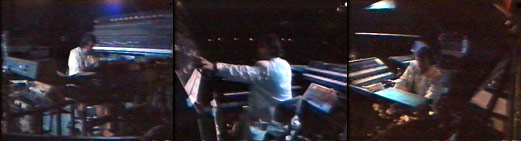
Also see the: Eyewitness report, with more info about this concert from a fan who was there to attend.
Olympic Flame ceremony (Athens, August 25, 1988)
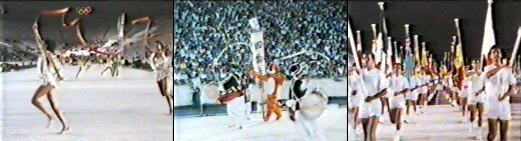
Vangelis performed live music in the Panathinaiko stadium, to accompany the lighting of the Olympic Flame in 1988. He composed and performed a lot of new music for the occasion, in the semi symphonic style he used for most of the concerts he performed in Athens. He ended the ceremony with a new instrumental version of the Greek traditional that appeared on "Odes" as "Les 40 Braves".
The event was broadcast live on Greek national television.
Acropolis Preservation Fund concerts (Athens, September 25 and 27, 1987)
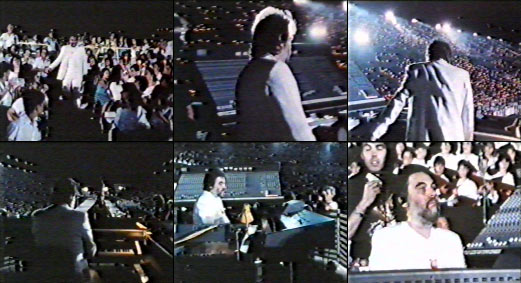
In 1987 Vangelis performed live for two evenings in his homeland Greece, to raise money for the Acropolis Preservation Fund, benefiting the Acropolis museum that can be visited on the top of this historic rock in Athens. The concerts where both performed at the Herodium theater, the most intact of the two ancient theaters that pride on the south side of the Acropolis. This venue later became world famous because of Greek pianist Yanni's performances, and Vangelis returned there later again also for his Night of Poetry / Antigone (1991) and Mythodea (1993) performances.
Live in Los Angeles (November 7 1986)
During Vangelis' stay in the US he unexpectedly gave a concert at the Royce Hall on Los Angeles' University campus. He set up his synths so he could single-handedly play live versions (in new improvised versions) of his famous works and improvise some new material. Sometimes the sound was a bit dry compared to his albums, because of the solo nature of his performance, but it certainly gave a special feeling to the proceedings. Vangelis' talent to variate on his melodies in unexpected fashion was displayed here in full glory.
The music included Pulstar, Missing, To The Unknown Man, Memories Of Green, Blade Runner Love theme, Abraham's Theme, Hymne, Chariots of Fire and the Tao of Love as well as some new material; most of which transformed gently into the next track.
Jon Anderson came on stage at some point and sang a few famous J&V songs, to Vangelis' spontaneous new arrangements. This unique display was enthusiastically greeted by the overjoyed audience. They began with a stunning new rendition of "Long Ago, So Clear" from the Heaven and Hell album. It was followed by "Italian Song" and "One More Time".
At the end Vangelis came up with a totally restyled version of the famous "Singing in the rain", which was one of the rare occasions were Vangelis publicly performed music that was not composed by himself. He made it his own though by rearranging it, pushing its flexibility to absolute limits.
Also see the: Eyewitness report, by Wade Major, who was present and attended the event.
Sophia Antipolis (August 17 1980)
This is a concert held at Sophia Antipolis, a place in the south of France, near Nice. Vangelis displays his remarkable one-man-orchestra techniques again playing almost everything himself, while making it sound like a complete setup of musicians, using only a limited amount of sequenced cues. A drummer was present for the rhythmic support and the occasional triggered sound effects.
Many different musical styles are represented. Besides Vangelis' usual improvisations (including "Beaubourg" style passages) he plays a wide spectrum of musical styles. A funny and entertaining jazz tune on organ sounds for example. And "Pulstar", which starts here as a dark slow-motion synthesizer combination, than evades into a contemporary piano piece, after that into some moody blues (still being recognizably "Pulstar") and finally into a typical "baroque string quartet" kind of thing.
Other well known compositions performed here are "The Long March" (China) and "Petite Fille De La Mer" with some nicely inserted "new" pieces with synthesizers and piano.
Royal Festival Hall (London, April 12, 1980)
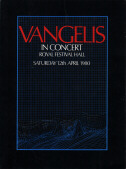
A concert with a bigger backing section than usual. There was percussion by Vassilis Constantinides as well as a string ensemble ("Spectrum string ensemble") conducted by Guy Protheroe.
Vangelis wrote in the concert program:
         "MEMORY OF THE FUTURE

         I believe that every human being, plant or animal carries
         a memory cell containing the imprint of the cycle of creation.
         Sound has always been parallel to the sequence of changes,
         as a code carrying the dimensions of the Universe.

         It takes one second to conceive
                             but a lifetime to explain...

                                                       and maybe more.

                                                              Vangelis"
The Pavillion (Paris, June 19, 1979)
At this concert, performed at the Pavillion concert hall in Paris, Vangelis improvised most of his performance, but it sounds surprisingly full, considering the era it was performed in. Although there was no way yet to work with MIDI setups and smartly split and layered multi-settings Vangelis managed to give a broad and lively performance with layered sounds.
The piano had a rather dominating role but was mostly accompanied by a wide variety of synthesizer sounds. Vangelis triggered some sequenced cues to accommodate the music. Only a few small parts feature other musicians. The most important of these is the appearance of violist Michel Ripoche, who performs "The Plum Blossom" from the China album.
Some parts of the new music are reminiscent of Ignacio (especially the piano part some 10 minutes into its first part) and China. Although a lot familiar cues appear, like the sequence of "I hear you now", very few actual pre-existing compositions were included. Among those that did appear were "Alpha" and of course "Pulstar", which Vangelis used to play every time he could, each in a different way.
Note: The year of 1979 is not a mistake. Many sources thoughout the years have erroneously suggested this took place in '78, and as sites and books are sourced partly from eachother, the mistake perpetuated. We were contacted by someone who attended the event and insists this happened in 1979, not 1978. The inclusion of tracks from China (1979), which was still to be in the pipeline for another year certainly backed up his story. Recently, a photograph of a ticket was posted on the web, confirming the date, but omitting a year. The omission of the year may account for the origin of the mistake, but more importantly, the ticket lists a day of the week: Tuesday. In 1978, June 19 was a Monday. In 1979, June 19 was a Tuesday. The concert happened in 1979.
Cirque Royale (Brussels, May 17 1979)
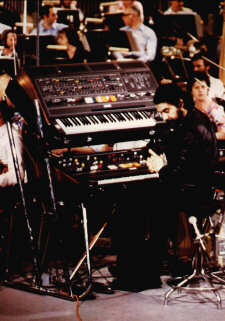
This concert featured Vangelis accompanied by a symphonic orchestra with choirs. It was organized by BRT2 (Belgian public broadcasting organization), "Omroep Brabant" (Belgian local broadcast service), "dienst schone kunsten" (an art organization) and the Belgian Royal Circus. It was broadcast live on the radio.
The music opened with Pulstar. It started as the usual version (except some synths replaced by the orchestra) and gradually transformed into a nice symphonic reworking with all sorts of variations on the theme. After that most of the China album was played, followed by some new material announced as "Vangelis solo 2". After that the crowd wouldn't stop cheering and Pulstar was played again as an extra.
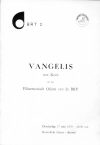
BBC Conductor John Pool conducted "Philharmonisch Orkest van Brussel" and the choirs "Leuvens universitair koor" and "Zing het samen (Antwerpen)". Michel Ripoche also appeared playing a violin solo.
There was a program for the show, with texts in Dutch and one fuzzy picture of Vangelis in black and white. The picture shows the cover of this program.
Drury Lane (London, April 22, 1979) (not April 28!!)
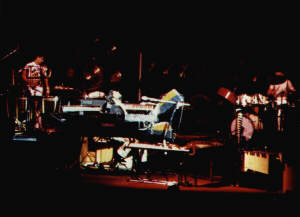
This concert in London mainly featured a lot of new improvised music. The inevitable "greatest hits" like "Pulstar" from the Albedo 0.39 album pop up only very briefly.
The new music is often rather expressionistic, consisting of strange sounds and atonal structures kind of like the album "Beaubourg". Yet some very melodic pieces are included like a romantic sounding piano piece. It starts softly with its main theme, than develops into a sequence part, featuring a "Multitrack Suggestion"-like sequence with an ever changing "Spiral"-like sound. On top of it Vangelis improvises on the piano. After that the piano theme start again with some gentle synthesizer sounds added. Vangelis shows himself a master in minimizing the needed parts, so that he can play as much as possible all by himself.
Also played were a number of Chinese styled pieces. Note that it was performed around the time the album "China" was recorded.
You can download a zipped MP3 file London.zip (176KB) with a 62 seconds excerpt from an audience recording of this concert. The strange "electronic" sound is the result of denoising technique to get rid of the original ambiance / tape noise.
Also see the: Eyewitness report, from a person attended the concert himself.
Royal Festival Hall (London, April 12???, 1977)
Vangelis gave a concert in London again, this time in the legendary hall where many of the greater classical performances were staged. Who can help with any more information on this concert?.
Royal Albert Hall (London, February 11, 1976)
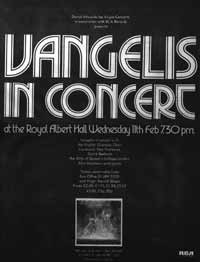
Pictured to the right is an ad for this concert published in British music paper "Sounds" (Feb 7, 1976). The show was staged right after the release of "Heaven and Hell". Vangelis himself said about this concert:
"We made a concert in Royal Albert Hall... and it was a very, very difficult thing. Difficult because you have to consider that you have a kind of music that is pure electronic, but doesn't sound electronic. And you have the mixture of keyboards and choir and percussions."
"There are so many many different things involved that it takes two days to set up all the gear. It is so difficult to make a balance because if you play pure electronically you have to balance that. We talk about electronic things today, we imagine always space sounds, but as you see this particular piece sounds like a symphony orchestra so sometimes I thought that it was much easier to use a symphony orchestra if than to play myself all the parts of the symphony orchestra! But it was a very good experience for me to do it."
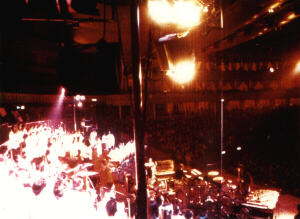
"I play the symphony orchestra with my keyboards and I use two percussion players, seven African percussion players- about one hundred and fifty people on stage. It was very good, their job."
Taken from "Vangelis the man and his music - Radio Special Self Portrait" (RCA), a 1975 promotion LP for Heaven and Hell, with excerpts from the album intercut with bits of a recorded interview.
Olympia (Paris, February 25, 1974)
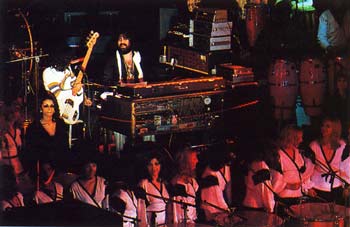
The first big concert Vangelis performed as a solo artist was organized at the "Olympia" in Paris, to promote his "Earth" album. A French music magazine ("Best", nr 69, April 1974) at the time wrote the following raving review:
At the Olympia - Impressive Vangelis
Just one word is sufficient to describe the show that Vangelis O Papathanassiou gave the 25th of February at the Olympia: A super-production! The show was befitting to the impressive Greek's appearance with his magnificent talent. Just consider: Thirty two chorus members, excellent ones that is, chanting the music with their voices but also banging a staggering set of timpanis. Six diabolical percussionists producing the wildest rhythms, full of richness. Robert Fitoussi, his base and particularly his pleasant voice. And right there in the middle of that, like Neptune the King Vangelis surrounded by his keyboards, running his fingers from piano to synths, spreading over these incredible rhythmic ensemble waves of enchantment. All of this for music that is truly magnificent, both imposing and bewitching, matured from "Earth" of which only two titles where performed (a splendid "My Face in the Rain"). Just beyond symphonism & diabolism, all of it directed by a major Mister showbiz who didn't forget the "Aphrodite's Child" lesson. We will soon be writing more about the musician that Vangelis is. A truly big man.
Herve Picart (translated by Antas and Dennis)
Queen Elizabeth Hall (London, May 27 1973)
Vangelis gave a concert at the Queen Elizabeth Hall in London, shortly after the release of the "Earth" album. The concert was part of a short festival of concerts, billed as "Peter Bowyer Presents", with two sets performing every night.
Vangelis' performance preceded John Hiseman's Tempest, who were then a very popular act, while Vangelis as a solo artist was a new name in the British music scene.
An article in a UK music paper (Sounds, in March 9, 1974), written during the preparations of the Olympia concert in Paris, notes: "Vangelis has been to Britain before, but his concert last summer at the Festival Hall supporting Tempest was, by his high standards, a failure. Nevertheless, two of his fans who inquired about 'Les Apocalypse des Animaux' recalled the concert fondly. One hopes that Polydor will see fit to release such a beautifully serene composition with underlying hints of Schonberg in Britain, if only for the beautiful 'Creation Du Monde'".
The concert was performed on Sunday evening, starting at 7:15. Mark Lyons was one of the few people to attend this event, but still recalls it well enough to share some details:
The hall was pretty much empty. Vangelis was joined on stage by Silver Koulouris. I did not recognise what they played. It seemed to be improvisation.
The concert was like a one off. It is hard to imagine that these days, when everything is done for a reason, to promote a specific release etc. There was nothing to be sold on the back of the QEH gig.
The hall was full for John Hiseman but I doubt if there were even 100 people there when Vangelis played. If I remember rightly it was part of a four or five day festival at the QEH over a bank holiday weekend.
- Mark Lyons
Before...
Of course Vangelis already had a lot of experience on stage, especially performing with the group "the Forminx", in which he played in the mid sixties. A band he had casually started with some friends at college in Greece, which became very popular in that country.
Another performance that is notable was at the age of six, performing in front of some 3000 people (according to reports) while improvising his own music on the piano.
