Interview in Sounds music newspaper, February 5, 1977
Shaping the studio to suit yourself
NEMO studios, set up by Greek-born keyboard / percussion virtuoso Vangelis a few hundred yards from London's Marble Arch, almost set a precedent in terms of a studio being sculptured into an extension of the owner's personality. The successful rock musician's private recording studio often turns out to be a seldom fully utilised gross self indulgence. With Vangelis the situation is entirely different.
In the 16 months since he recorded his first project in the studio (his own 'Heaven And Hell' album) he has worked there consistently for between ten and twelve hours a day. I estimate that had he hired a commercial studio with similar facilities he would have spent well over a quarter of a million pounds.
Several years hard work combined with a lucrative new recording contract with RCA finally placed him in the financial position to proceed with his dream project - a studio of his own.
Apart from the occasional choir or vocal contribution from his sometime side-kick Jon Anderson, Vangelis creates all the sounds on his complex sounding albums himself though the average listener could be forgiven for believing a whole symphony orchestra was playing.
The studio control room is large, at least half as big again as the biggest of the commercial studios.
The main studio is approximately 45ft x 120ft and has a moveable stage at one end, used as a general discussion area and also for concert rehearsals. The now much modified desk was bought along with a 16-track tape machine from Command Studios. With bits and pieces being added along the way and builders building, somehow Vangelis managed to record his first solo album to receive critical and public acclaim, 'Heaven and Hell', which I suspect is what he went through until shortly afterwards when he was joined by engineer Keith Spencer-Allen. According to Keith they're still developing the studio in technical terms.
"Apart from developing basic techniques we're still experimenting to develop the studio to meet the demands of the synthesiser. Vangelis has now perfected orchestrating songs purely with synthesisers duplicating traditional orchestral sounds. Now he is concerned with using the synthesiser as an instrument in its own right. He uses the desk very much as an instrument using perhaps three graphic equalisers with echo and whatever on just one instrument, then perhaps laying down a unison track with subtle differences. He expresses himself through the desk."
Frequently, when it comes to mixing down, Keith takes a back seat keeping an eye on technicalities while Vangelis takes the helm at the desk. Vangelis says:
"Yes, the desk is an extension of my instruments to me. A mike is a technical ear, that is all. I take the sound from the mike or with direct injection, as the case may be, and it's like... you know when you take a photograph and then you make a print, the print is really the picture. The negative is just a process. So mixing for me is like the printing of a picture, the desk is the real instrument."
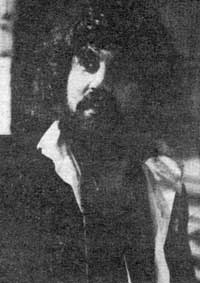
VANGELIS: the desk is the real instrument
The importance of Keith Spencer-Allen as engineer becomes more obvious talking to Vangelis. He just won't be drawn into technical discussion, preferring to leave all that to his trusty right hand man.
"When Keith talks about me using Barcus Berry and all that, well many people do. What is important is what you do with these things."
The degree of experimentation and exploration of sound can be gauged by their approach with echo. They use no less than twelve echo units as well as natural acoustics. The studio has a high ceiling and a hard floor covering that gives the kind of live sound on percussion that is once again becoming fashionable. Also used is the well of the entrance stairway which has excellent natural echo. The most recent addition to the equipment is a DBX noise reduction unit which is used on all 16-track recordings. Only a handful of studios use DBX as opposed to the more widely used Dolby system.
They find the system a boon when Vangelis' music goes from a single instrument played quietly to a full crescendo in the space of a few seconds. The unit has record and replay facilities combined in one unit, but there are also two Dolby units for masters that leave the studio.
The desk is an Automated Process model much modified to suit the electronic music which provides the basis for almost all the work done at the studio.
The basic philosophy of the studio is simple. Vangelis and Keith have to spend a lot of time working together sometimes for months on end. The apparent extravagance and accent on comfort are in fact both economic and practical factors in the long run, for it is unlikely that they could work for such long periods in more run of the mill surroundings.
Interview by Ralph Denver
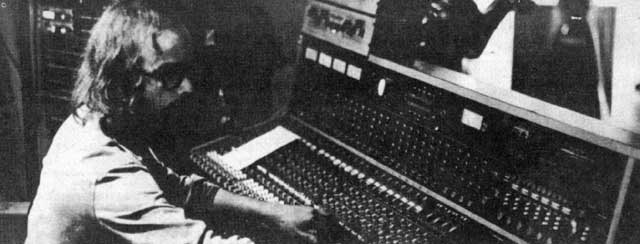
KEITH Spencer-Allen at the controls of the Automated Process desk at Nemo Studios.
